

A Stroll Down Football's Memory Lane
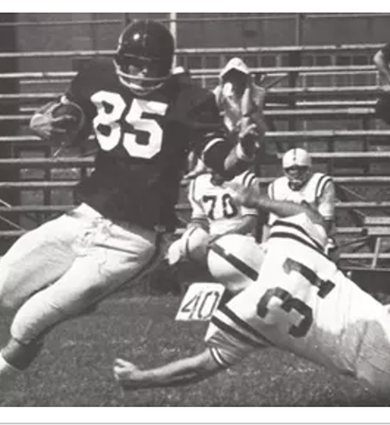
Sixty years after stepping onto the field as a Carroll football player, Bill Wick ’70, returned to discover how much the game has changed — and how much remains the same.
In 1966, I was a football player from Milwaukee’s Bay View High School when I walked into the locker room at Van Male Field House for my first two-a-day practices at Carroll College. Sixty years later, after playing four years for the Pioneers, I returned to spend a day with Carroll University’s football team.
Walking into Van Male Field House again was a thrill. The building had been considerably renovated, and Carroll’s distinctive streaking Pioneer logo had replaced the familiar Carroll “C” that once appeared on our helmets — a logo I always thought looked a little too much like that of the Chicago Bears.
Much has changed since 1966. Carroll was still a college (not a university); helmets were hard-shell models with face masks and players didn’t wear gloves. The Green Bay Packers had won the first two NFL-AFL Championship Games, now known as the Super Bowl. College football had four major bowl games but no playoff system. The Beatles were in their prime, Lyndon Johnson was president and the country was becoming increasingly embroiled in the Vietnam War.
Fast-forward six decades, and I had the pleasure of spending the day with Head Football Coach Mike Budziszewski, his staff and the Pioneers. I expected changes. What surprised me was how much the game and its preparation had evolved — and how much the spirit of the team had stayed the same.
A Different Field, a Different Game
The first difference was impossible to miss: the facilities.
Van Male Field House remains an important part of Carroll athletics, but Schneider Stadium is now a first-class Division III football venue. It was an honor to know Ollie Van Male and Jim Schneider, whose generosity helped make opportunities like these possible for generations of Carroll athletes.
In 1966, we crossed Barstow Street and walked down a ramp to the practice field, near what is now the south end of Schneider Stadium. A steep hill bordered one side, while the Aqua-Chem plant stood on the other. We had to be careful running sweeps and pass patterns near the building. Nobody wanted to get knocked into the wall.
Today, players walk directly from a spacious locker room onto synthetic turf. Inside, I found the locker donated by my wife and me, beside one donated by my friend and teammate Claude Covelli, whom I consider among Carroll’s best offensive linemen. Seeing those lockers reminded me that the relationships formed during football seasons often outlast memories of individual statistics and long-forgotten wins and losses.
The coaching staff has grown, too. In 1966, we had two coaches. Today, Coach Budziszewski has eight assistants, and the roster has expanded from about 50 players to approximately 125. Today's players are also bigger, stronger and faster.
One thing, however, hasn't changed: football players love the start of the season and hate training camp. Somehow, the hottest week of summer always seems to coincide with two-a-day practices.
From Two-a-Days to Data Overload
Our practices in the 1960s were straightforward. We spent about two hours on the field in the morning and another two in the afternoon. Coaches told us what to do when we arrived, and we did it.
Today, preparation is much more structured. Practices are organized into timed segments, followed by film review and position meetings. Coaches spend long days evaluating players, reviewing film and preparing for what comes next.
Technology has transformed the process. In my day, coaches and players primarily watched game films on Kodak Super 8. Today, every practice is recorded, footage is broken down by position and drones provide aerial views of drills and scrimmages. Analytics help coaches evaluate performance in specific situations, even at the Division III level.
Quarterbacks once called their own plays. Now, coaches can communicate with them through speakers in their helmets. During my visit, I was given a headset and listened to coaches communicating with assistants and the quarterback. Such technology would have seemed unimaginable in 1966.
The play calls themselves might be the biggest adjustment for an old-timer like me. Our calls were relatively simple: “Split Right, Flank Left, 34 Trap on 2.” Today, a play might be called “Pro Right B Wheel Read Bravo” or “Cougar Right A Leap CV Under.”
After hearing some of today's terminology, I understand why players need so much time to learn a new offense. You almost need a Ph.D. to understand some of the defensive adjustments.
Beneath all the terminology and technology, however, the fundamentals remain recognizable.
Protecting the Players
One of the most welcome changes is the emphasis on player safety.
In the 1960s, practices involved considerably more physical contact. Today, coaches limit tackling and taking players to the ground to reduce unnecessary injuries. Athletic trainers are present at practices, and concussion protocols provide a structured response to potential head injuries.
In my playing days, a sniff of smelling salts and a quick check from the trainer could send a player right back into the game. There were no medical tents, and our training room consisted of two examination tables and a whirlpool.
The modern approach reflects a greater understanding of football's risks and the importance of protecting athletes beyond their time on the field.
More Than a Word on a Jersey
As impressive as the facilities and technology were, the most meaningful discovery of my visit had little to do with football mechanics.
Every player wore a practice jersey with the word “family” on the back. Watching the team throughout the day showed me why. Players encouraged one another, helped teammates understand the system and stood up for one another. Coaches and players interacted with genuine respect and a sense of responsibility.
I also learned of a player who had been seriously injured in an accident and hospitalized without family nearby. Coach Budziszewski spent the night with him so he wouldn't have to face the experience alone. He did it because, to him, that's what a coach does.
That simple act said more about the program than any statistic could.
The team's commitment extends beyond football. Carroll players contributed approximately 4,000 hours of community service over the past year and maintain a cumulative grade-point average of 3.2. The old stereotype of the “dumb jock” is clearly outdated.
The Things That Matter Most
After spending a day with the Pioneers, I came away impressed by the players and coaches and grateful for the warm welcome extended to an old alumnus.
Division III football is played for the love of the game. Carroll athletes aren't there for multimillion-dollar contracts or the promise of professional careers. They are there to compete, learn, represent their university and be part of a team.
I have particular respect for offensive linemen and nonstarters. Linemen are essential to the success of the skill players, yet they rarely receive attention unless they miss a block or draw a penalty. Everyone wants to be a star, but the players who take pride in supporting teammates and contributing outside the spotlight deserve tremendous credit.
After 60 years, I believe the old saying still holds true: the more things change, the more they stay the same. Football is more sophisticated, analytical and attentive to player safety than it was in my day. But games are still won through blocking, tackling and sound fundamentals. Most importantly, the relationships and shared experiences remain what make playing college football meaningful.
If you have the opportunity to attend a Carroll football game or another athletic event, I encourage you to do so. And if you are able to support Carroll athletics financially, consider investing in the students who benefit from these experiences.
My day with the Pioneers was a stroll down memory lane, but it was also a reminder of why I am proud to have been a Carroll football player.
A Carroll football player is someone a youngster in the stands looks up to and hopes to become — and someone an old man can look at with affection, remembering who he once was.
Sixty years later, I still feel that pride.
